Chapter 3 — Factors of Production
Cambridge International AS & A Level Economics (9708) · Unit 1.3 · 4th edition coursebook
Learning objectives
- Define the meaning of the factors of production: land, labour, capital and enterprise.
- Explain the importance of the factors of production.
- Describe the rewards to the factors of production.
- Explain the difference between human capital and physical capital.
- Explain the division of labour and specialisation.
- Explain the role of the entrepreneur in the organisation of the factors of production in 21st century economies and as a risk taker.
Key terms
- entrepreneur
- An individual who seeks out new business opportunities and is willing to take risks.
- land
- A factor of production; natural resources in an economy.
- labour
- A factor of production; human resources available in an economy.
- low-income countries
- Economies where income per head was $1025 or less in 2018 (World Bank).
- capital
- A factor of production; a physical resource made by humans that aids the production of goods and services.
- enterprise
- As a factor of production, enterprise involves organising production and taking risks.
- physical capital
- Factors of production such as machinery, buildings and infrastructure.
- economic growth
- In the short run, an increase in a country's output and, in the long run, an increase in a country's productive potential.
- lower middle-income countries
- Countries where income per head was between $1026 and $3995 in 2018 (World Bank).
- human capital
- The value of labour to the productive potential (future growth) of an economy.
- specialisation
- The process by which individuals, firms and economies concentrate on producing those goods and services where they have an advantage over others.
- division of labour
- Where a manufacturing process is split into a sequence of individual tasks.
- high-income countries
- Economies where income per head was $12,376 or more in 2018 (World Bank).
3.1The factors of production
The fundamental economic problem (Chapter 1) tells us that resources are scarce while wants are unlimited, which forces choice. Economists call the resources available to an economy the factors of production — the inputs that an economy uses to produce the goods and services its population needs. The owners of factors of production are paid when those factors are used by others. There are four main factors, summarised in Figure 3.2.
Land
Land is a natural resource. It is a broad category that includes mineral deposits such as oil and coal, rivers, lakes, climate, soil for agriculture, forests, and natural features such as sea and sand that support tourism and leisure. Both the quantity and the quality of land matter: too little rain, too much sun, or poor soil can render this factor of limited productive use. With climate change, the quality dimension of land has become more important. The reward to land is rent — or, in the case of minerals, the payment received for the resources extracted.
Labour
Labour is the human resource available in an economy. Both the quantity and the quality of labour matter. Some economies — particularly low-income countries — have large populations but lack well-trained and well-educated workforces; not all of the population is available for work, and cultural factors may limit who works and in what roles. Other countries have declining populations and rely on immigrant workers to fill skilled and unskilled jobs. The reward to labour is wages (or salaries / earnings) and depends on the value of labour's services to whoever is hiring.
Capital
Capital is a physical resource — anything that humans have made to aid production. It covers factories, office blocks, machinery, IT equipment, transport vehicles, and infrastructure such as roads, railways, pipelines, electricity supply, and water supply. Capital is combined with land and labour to produce the goods and services people want. As with the other factors, the quality of capital matters as well as the quantity — particularly in lower-income economies, where essential services depend on reliable capital infrastructure. The reward to capital is interest (or income if the capital resource is rented out).
Enterprise
Enterprise is a form of human capital with two roles: it organises the other factors of production so that goods and services can be made, and it carries the ability and willingness to take risks — characteristic of the entrepreneur. Most entrepreneurs are not the globally famous founders of major firms; most are the many millions of people who run small businesses and organise factors of production to earn a profit. The reward to enterprise is profit.

Economists classify capital as produced, human-made resources, land as natural resources (including unmined minerals and forests), labour as human effort, and enterprise as risk-bearing rewarded by profit. Option C – land includes forests and undiscovered copper – correctly identifies these as natural resources. Shares are financial, not real, capital (A); labour is human, not human-made (B); and enterprise earns profit, not interest (D).
3.2The difference between human capital and physical capital
Strictly speaking, the factor of production called 'capital' is more accurately described as physical capital — the stock of factories, machinery and infrastructure that firms and governments have built up. The quality of physical capital, as well as the quantity, is often regarded as the most important source of economic growth in low-income and lower middle-income countries.
Economists also use the term human capital. Human capital is the value of labour in contributing to an economy's productive potential — its capacity for future growth. It captures the skills, knowledge and experience of the workforce. Human capital can apply to individuals and to the population as a whole, and it has a direct influence on the future earnings of individuals and on the economy's growth rate. For that reason, investment in human capital — by individuals, employers, and governments — is one of the most important determinants of long-run growth.

Capital is the textbook 'produced means of further production' — goods such as machines, tools and buildings that are themselves produced and then used to make other goods. Option A – capital – fits exactly. Land is a natural (not produced) resource, labour is human effort, and enterprise is the risk-taking factor, so none of them are produced means of production.
3.3Specialisation and the division of labour
One of the main ways an economy can produce more goods and services is through specialisation. Specialisation is the practice by which individuals, firms, regions, and entire economies concentrate on producing some goods and services rather than others, focusing on areas where they have a relative advantage.
Specialisation operates at every level. Within a household, one person may do the cooking while another does the cleaning. In the workplace, some people are labourers, others are office workers, others are teachers — and that pattern of role assignment reflects specialisation. At the firm, regional, and national levels, specialisation means concentrating on what each unit does best. The result is that more goods and services are produced overall than if everyone tried to do everything.
Specialisation requires exchange. No one is self-sufficient once they specialise — they need to trade what they produce for what others produce. Each specialised producer ends up with a surplus of their own output, which they exchange for other people's surpluses.
Specialisation carries risks as well as benefits. The pace of technological change means that the specialist skills any individual or region has acquired may become obsolete. Workers need to remain flexible and able to move between occupations. At regional and national levels, shifts in consumer wants can leave previously productive specialisms unwanted, causing unemployment that policy then has to address.
The division of labour
As production has scaled up over the last few centuries, large numbers of workers within a single production unit have allowed the production process itself to be split into separate tasks. This is the division of labour. A garment factory is the standard example: each worker produces one specific part of an item — a sleeve, a front panel, button-holes — rather than completing the whole garment.
The advantages are clear. Workers become more skilful at the narrow task they perform; output per worker rises; the quality of the finished product usually improves; and unit costs typically fall. In high-income countries, the division of labour has been extended through conveyor-belt production and, more recently, automation.
The disadvantages also matter. A narrow, repetitive task can be tedious; workers may become de-skilled and bored, with the dehumanising effects of monotonous work damaging both well-being and productivity. Firms in high-income countries have used job rotation and other practices to counteract this effect. There is also a risk of vulnerability: a worker with a single specialised skill is harder to redeploy if the task disappears or the industry contracts.
Key concept link — scarcity and choice
Through specialisation and the division of labour, resources that are available can be used to increase what is being produced, so meeting more wants.
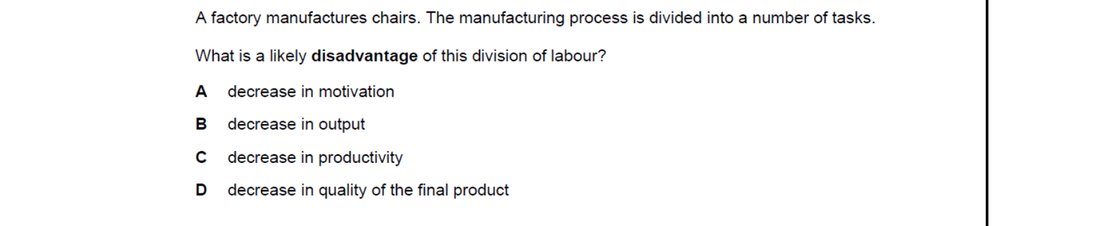
Division of labour breaks production into narrow, repetitive tasks. While this typically raises productivity and output, the chief human cost is boredom and disengagement. Option A – a decrease in motivation – is therefore the likely disadvantage. Output, productivity and quality (B, C, D) generally improve through specialisation, not worsen, so they describe benefits rather than drawbacks.
3.4The role of the entrepreneur
Entrepreneurs are individuals who do two distinct things. First, they organise production — they bring together the various factors of production into a business that can deliver a good or service. Second, they take risks — using their own money, or money borrowed from banks or other people, to back a venture whose success is uncertain. Risks are considerable: if the venture fails, entrepreneurs lose their own money and that of others.
Successful entrepreneurs share certain qualities. They are creative, finding new combinations of inputs or new product ideas. They are innovative, willing to deviate from how things are usually done. They are leaders, able to organise a team around a shared goal. They anticipate current and future needs, identifying gaps before competitors do. They produce something the market wants — passion alone is not enough. And they often have an element of good fortune: even excellent decisions sometimes need favourable circumstances to succeed. Figure 3.5 summarises these qualities and skills.
Most entrepreneurs are not the founders of multinational corporations. The far larger group are the millions of people who run small and medium-sized businesses, organising local factors of production to make a profit. Both groups perform the same economic function: they combine inputs into output and bear the risk of being wrong.

Enterprise is the factor of production that organises the other three and bears uncertainty. The defining feature is willingness to commit resources to ventures with uncertain returns. Option D – taking risks – captures this. Attracting customers, buying stock and managing staff (A, B, C) are everyday managerial tasks that any business does, not the unique requirement that distinguishes an entrepreneur.
End-of-chapter practice
Past-paper questions from CIE 9708. Pick A, B, C or D. Answers are saved on this device — press Download report (PDF) at the top to save them.
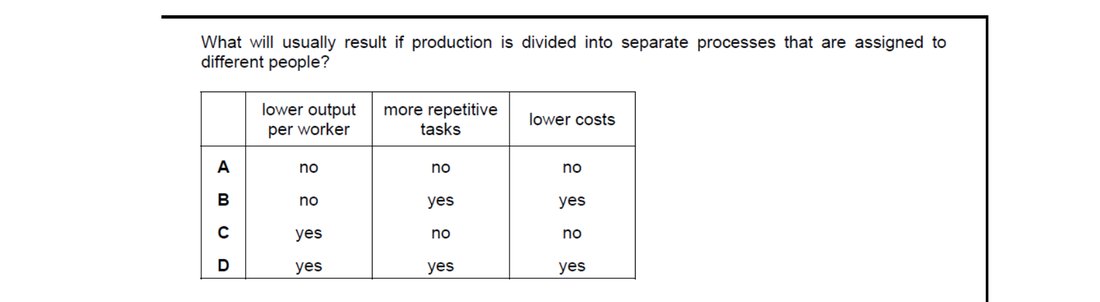
Splitting production into separate processes (division of labour) makes each task more repetitive and, through specialisation, lowers cost per worker, while output per worker rises rather than falls. Option B – no to lower output per worker, yes to lower costs, yes to more repetitive tasks – matches this pattern. Rows that predict lower output per worker (C, D) contradict the productivity gains specialisation delivers.
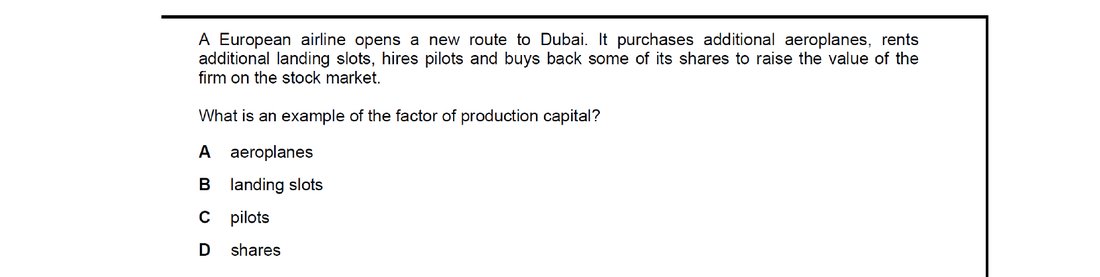
Capital as a factor of production refers to produced, physical goods used to make further output. Option A – aeroplanes – are clearly produced capital goods. Landing slots are a form of land/rights, pilots are labour, and shares are financial capital (a paper claim), not the economist's definition of capital. So A is the only real-capital example.

Each factor of production earns a distinct reward: land earns rent, labour earns wages, capital earns interest, and enterprise earns profit. Option A – interest – is therefore the payment for using capital. Rent (C) belongs to land, wages (D) to labour and profit (B) to enterprise, so they pair with the wrong factors.
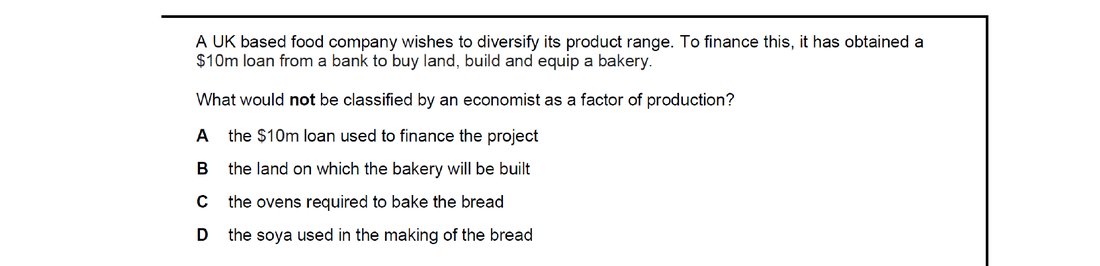
Factors of production are real inputs: land, labour, capital and enterprise. Option A – the $10m bank loan – is finance, a money flow used to acquire factors, not a factor itself. The land, ovens (physical capital) and soya (a raw material/intermediate input) are real resources used directly in producing bread, so they are factors of production.

Enterprise organises the other factors and bears the uncertainty of production, and its reward is profit — the residual after rent, wages and interest are paid. Option D – profit – matches. Enterprise (A) is the factor itself, not its reward; interest (B) rewards capital; and wages (C) reward labour, so they cannot be the return to risk-taking.

Division of labour normally lowers average costs, raises productivity and improves quality through specialisation, but the narrow, repetitive nature of tasks tends to reduce job satisfaction. Option B – an increase in motivation – is therefore not a likely result; motivation typically falls. The other outcomes (A, C, D) are the standard benefits of specialisation.
Attempt the practice questions above to build your score.
Self-evaluation checklist
After studying this chapter, you should be able to:
- Understand the nature of the four factors of production: land, labour, capital, enterprise.
- Describe the rewards for each of the factors of production.
- Explain the difference between human capital and physical capital.
- Explain why more goods and services can be produced in an economy through the process of specialisation.
- Explain that the division of labour enables the more efficient use of factors of production.
- Explain the role of the entrepreneur as an organiser of factors of production and a risk taker.
Want more practice? Drill this chapter's past-paper MCQs (39 questions) →